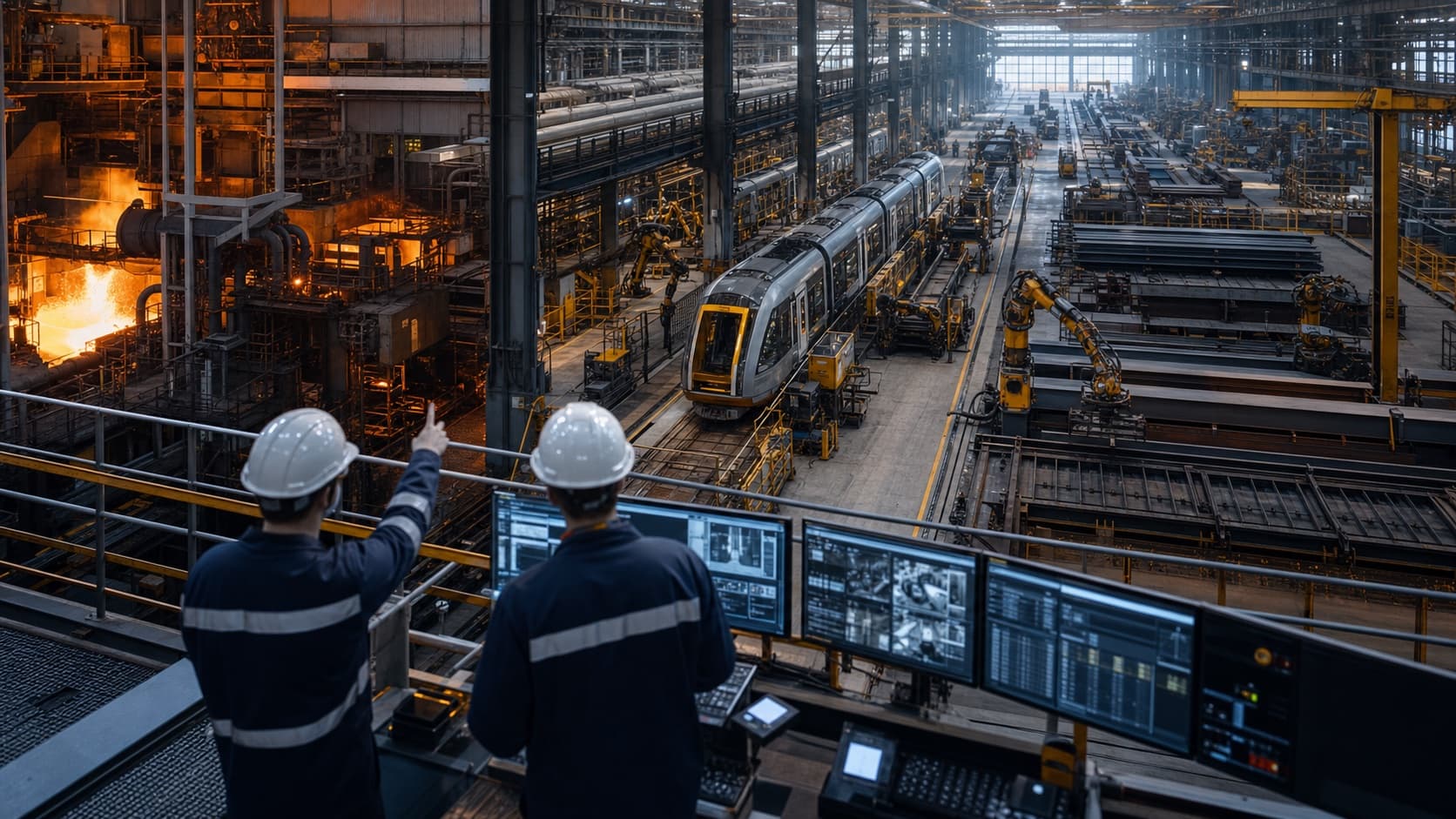
The next industrial transformation will not be led by a single autonomous factory. It will emerge through thousands of connected improvements: safer inspections, better maintenance decisions, more stable production, stronger quality control and clearer management visibility. In metallurgy, steelmaking, rail rolling stock and infrastructure, AI matters when it helps physical operations perform with greater discipline.
The last frontier of automation is not a clean laboratory
Heavy industry does not operate in the controlled world of a software demonstration. Steel plants, foundries, rail depots and infrastructure sites contain heat, vibration, dust, large moving loads, ageing assets and processes that cannot simply be paused when a model is uncertain. This is why automation arrived unevenly. Automotive factories could standardize products and movements around highly repetitive lines. Large industrial structures, metallurgical processes and infrastructure projects are more variable. Components are heavy, sites change and the consequences of a poor decision can affect safety, quality and production continuity. The World Economic Forum describes heavy industry as one of the last frontiers of automation. That does not mean it is digitally empty. It means the remaining problems are difficult. The opportunity for AI is therefore not to replace engineering reality with software. It is to make complex physical operations more observable, predictable and controllable.
From isolated automation to connected industrial intelligence
Traditional industrial automation follows defined logic. A programmable controller receives signals and executes a known sequence. This remains essential because deterministic control is reliable, fast and understandable. AI adds a different capability. It can identify patterns in sensor data, images, maintenance records and production history that are difficult to express as fixed rules. It can support forecasts, classify anomalies and help teams compare current conditions with previous events. Generative systems can also make complex information easier to retrieve through natural language. The strongest architecture keeps these roles separate. Safety-critical control remains inside validated industrial systems. AI observes, advises and optimizes within defined limits. Human experts approve consequential changes. The result is not a plant handed over to an algorithm. It is a layered operating model in which machines execute, AI interprets and people remain accountable.
Steelmaking: intelligence at the point of production
Modern steel production already depends on models, automation and continuous process data. The new step is to connect more of that information across equipment, quality, energy, maintenance and logistics. In June 2026, ArcelorMittal announced a collaboration with AWS focused on bringing cloud, edge and AI technologies to production environments. The company identified predictive maintenance, computer-vision quality control, process optimization and digital twins as application areas. This is a corporate program and should be evaluated as such, but it demonstrates the direction of travel for a global producer. The important phrase is "at the point of production." Steelmaking decisions often lose value if information arrives after the heat, rolling campaign or maintenance window has passed. Industrial AI becomes useful when it reduces the time between a signal, an interpretation and a controlled action.
Metallurgy still requires process knowledge
A metallurgical process is not a generic dataset. Temperature, chemistry, feedstock condition, equipment state and process timing interact. A statistical relationship can be useful, but it must be interpreted against physical mechanisms and operating limits. This makes domain expertise a strategic asset. Metallurgists and process engineers define which variables are meaningful, which deviations are tolerable and which recommendations are physically unrealistic. They also understand when data quality is compromised by sensor drift, calibration or changes in raw material. AI can help teams explore complex relationships and detect patterns earlier. It cannot remove the need to validate recommendations against process knowledge. The best systems will be designed with operators, maintenance teams and engineers, not delivered to them as a finished black box. In heavy industry, adoption depends as much on credibility at the plant as on accuracy in a test environment.
Quality control becomes continuous
Computer vision can inspect surfaces, dimensions, markings, welds and packaging at speeds that manual inspection cannot match. In steel and metal processing, this can support the earlier detection of defects and reduce the amount of material that advances through production before a problem is understood. ArcelorMittal Poland has publicly described the use of computer vision to read railcar numbers and robots to package heavy coils. It also reports using drones for plant mapping and monitoring bulk-material volumes. These examples show that industrial vision is not limited to product defects; it can support logistics, inventory and safer inspection. Continuous inspection does not make quality departments obsolete. It changes their work. Specialists investigate patterns, validate classifications, manage exceptions and improve the inspection system. A false positive can create unnecessary stoppage; a false negative can release defective material. Performance must therefore be measured against real production consequences.
Predictive maintenance: from probability to decision
Predictive maintenance is one of the most discussed industrial AI applications, but prediction alone is not the business outcome. A model may indicate that failure risk is increasing. The organization must still decide whether to continue operation, inspect, slow the asset or intervene immediately. That decision depends on safety, spare parts, production plans, access, workforce and the cost of an unplanned stop. The maintenance workflow needs to connect the model to these operational realities. A useful system ranks evidence, shows confidence and provides the history behind an alert. It routes the issue to a responsible engineer and records the action taken. Over time, the company can compare predictions with actual failures and interventions. Without this closed loop, predictive maintenance becomes another dashboard. With it, maintenance can become more planned, more evidence-based and less reactive.
Logistics inside the steel plant
Steel plants move enormous quantities of raw material, semi-finished products, coils, plates, beams and scrap. The production process can be efficient while internal logistics still creates waiting, reshuffling and risk. ArcelorMittal's AM/NS Calvert project used a machine-learning model and hybrid simulation to support slab-yard operations. The company described the system as adjusting strategies in response to process flow and production demand. The reported example matters because slab handling is not a simple route-planning problem: material identity, sequence, crane availability and downstream requirements interact. AI-supported logistics can improve decisions about placement, movement and retrieval, but only when identification and inventory data are reliable. The lesson is broader than one plant. Before optimizing a physical flow, the company must know what it has, where it is and what the next process requires.
Rail rolling stock becomes a data-producing asset
A modern train contains onboard diagnostic systems that continuously produce information about components and operating conditions. The challenge is turning that stream into maintenance decisions without overwhelming teams with alarms. Siemens Mobility's Railigent X materials describe the use of train and wayside data to support condition-based maintenance. Its Health States use case addresses a practical question: can a train remain in service until the next planned interval, or should it enter maintenance earlier? This is the correct level of industrial AI. The output is not simply "failure predicted." It is evidence for a decision about availability, risk and maintenance timing. Rail operators and maintainers still need engineering rules, fleet context and regulatory compliance. AI helps prioritize attention and plan work around asset condition rather than relying only on fixed mileage or calendar intervals.
Inspection of tracks, bridges and structures
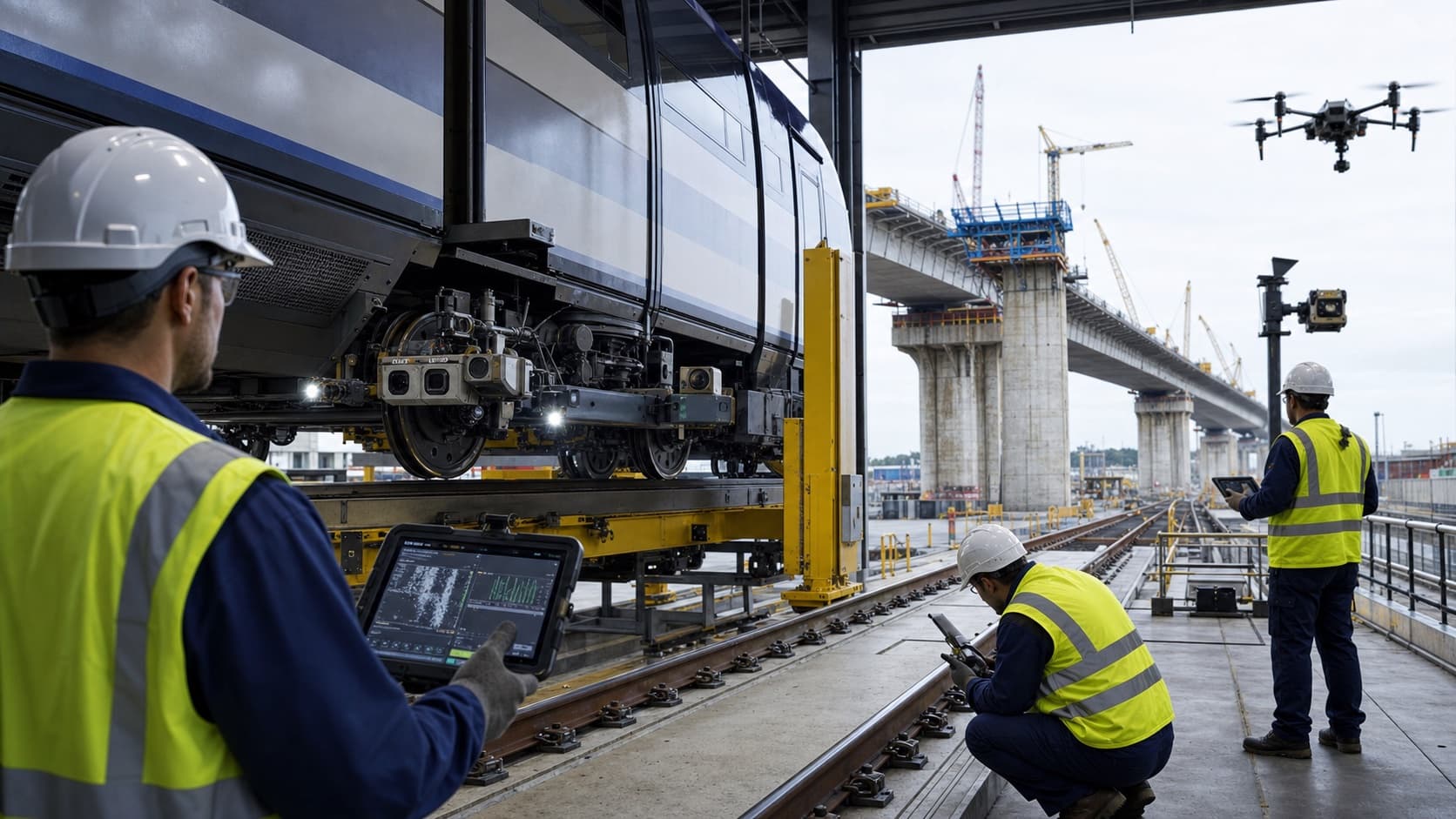
Infrastructure inspection combines scale with difficult access. Tracks, bridges, tunnels and elevated structures must be examined repeatedly, while traffic and site conditions limit inspection windows. Computer vision, drones and sensor analytics can help identify areas that require closer human examination. Images can be compared over time, defects can be classified and inspection records can be connected to asset history. This can improve coverage and make scarce engineering time more focused. The limitations are equally important. Lighting, weather, vibration, dirt and different camera angles can affect observations. A model may detect a visual change without understanding its structural significance. AI should therefore support an inspection regime, not pretend to replace one. Engineers must define thresholds, verify findings and determine the intervention. Traceability matters because infrastructure owners need evidence, not merely an automated alert.
Large infrastructure production resists fixed automation
Bridges, offshore structures, ship sections and modular infrastructure differ from high-volume consumer products. The workpieces are large, production volumes may be low and the geometry can vary. Fixed automation becomes difficult to justify when the product does not repeatedly arrive in the same position. The Large Structure Production Center described by the World Economic Forum is exploring mobile robotics, AI-driven planning and digital twins for large, complex structures. The logic is adaptive rather than fixed: machines and software must respond to the product and the workspace. For infrastructure contractors, this suggests a gradual path. Digital design information can support automated measurement, cutting, welding and inspection. Simulation can test sequences before material is committed. Robotics can take on repetitive or hazardous tasks. But project-specific tolerances, field conditions and coordination remain central.
Digital twins connect design and operation
A digital twin is useful when it represents a real asset or process closely enough to support a decision. In heavy industry, twins can combine design geometry, equipment state, process data and operational history. During design, simulation can help test layouts, robot reach, material flow and maintenance access. During operation, the model can provide context for sensor data and planned interventions. In infrastructure, the same concept can connect construction records with long-term asset management. The risk is creating an impressive visualization that is not maintained. A twin without current data becomes a historical model. Companies should define the decisions the twin will support, the source of each data element and the owner responsible for keeping it useful. The business case comes from reduced rework, safer planning or better asset performance, not from the visual interface itself.
AI agents enter the industrial organization
Industrial transformation is not limited to machines. Engineering, procurement, quality and commercial teams spend significant time searching documents, preparing reports and coordinating exceptions. World Steel Association published a 2026 member announcement describing Tata Steel's deployment of more than 300 specialized AI agents across its organization in nine months, using Google Cloud technology. The announcement identifies asset maintenance and customer response among the applications. As a company-reported deployment, its outcomes require the same critical reading as any vendor or corporate case. The strategic point is that agents can connect technical and administrative workflows. An agent may prepare maintenance context, compare specifications or organize a quality case. It should operate with approved sources, limited permissions and human review. Industrial knowledge remains the standard against which its output is judged.
Workforce impact: removing people from risk, not from relevance
Automation changes tasks before it changes entire occupations. In heavy industry, some of the strongest use cases move people away from heat, height, confined spaces, repetitive lifting or hazardous inspection. At the same time, new responsibilities appear. Someone must validate data, maintain sensors, interpret models, investigate exceptions and manage the connection between operational technology and information technology. Experienced operators become essential because they recognize conditions that are absent from formal documentation. The workforce strategy should therefore combine safety, capability and participation. Companies need training not only in software, but in how AI recommendations should be challenged. Employees should understand what the system can access, what it cannot know and who remains accountable. Adoption imposed without operational credibility will be fragile, regardless of technical quality.
Cybersecurity and the convergence of IT and OT
Connecting plant-floor data with cloud and AI services creates opportunity, but it also changes the security boundary. Operational technology was often designed for reliability and long equipment life, not continuous exposure to modern digital services. Industrial AI programs must separate observation from control, minimize access and create clear zones between systems. Credentials, models and data pipelines require monitoring. A compromised administrative account should not become a route to production equipment. Governance must also cover model updates and external content. An AI agent that reads supplier documents or websites can encounter manipulated information. High-consequence actions should require explicit approval and deterministic safety controls. The more connected the operation becomes, the more important architecture, logging and incident response become. Digital transformation without industrial cybersecurity is not modernization; it is transferred risk.
Where the business case is strongest
The best opportunities share three characteristics. First, the process produces enough reliable data to evaluate performance. Second, the operational pain is visible: downtime, rework, energy, waiting, safety exposure or lost availability. Third, a responsible owner can act on the result. Computer-vision inspection, maintenance prioritization, energy optimization, material tracking and document intelligence often meet these conditions. Fully autonomous production decisions may not. Leaders should begin with a baseline. Measure the current defect escape rate, inspection effort, unplanned downtime, maintenance backlog, handling moves or decision delay. Pilot the AI-supported workflow in a controlled area and compare outcomes. Include failure modes and human workload, not only average accuracy. Scale only when the process performs under real conditions and the operating team trusts it for defensible reasons.
A practical roadmap for industrial leaders
Start with the asset and the decision, not with a general AI strategy. Identify one operational constraint and map the information, systems and people involved. Improve data quality before attempting advanced optimization. Sensor reliability, equipment identity, maintenance history and document control are foundations. Define where AI may advise and where deterministic control or human authorization remains mandatory. Build a cross-functional team involving operations, engineering, maintenance, IT, cybersecurity and frontline users. Test the workflow against abnormal conditions, not only normal production. Record recommendations, decisions and outcomes so the system can be evaluated over time. Finally, scale the operating model, not only the algorithm. Reusable permissions, monitoring, validation and change control allow a company to deploy additional use cases without rebuilding governance from zero.
Conclusion: heavy industry will become more human-led and machine-supported
AI will influence heavy industry most where it respects the nature of heavy industry. Steelmaking, metallurgy, rail and infrastructure depend on physical assets, engineering standards and people who carry responsibility for safety and continuity. Automation can take on hazardous, repetitive and data-intensive work. AI can help teams see patterns, prepare decisions and coordinate complex information. Digital twins can improve planning, while robotics can extend precision into tasks that resisted fixed automation. None of these technologies removes the need for industrial judgment. They raise its leverage. The plants and infrastructure organizations that benefit will be those that combine operational knowledge with disciplined digital architecture, measure real outcomes and keep accountability visible. The future is not an autonomous industry without people. It is an industry in which people can manage more complex systems with better information and less unnecessary exposure to risk.