
The defining feature of artificial intelligence in 2026 is not a single model or product. It is the movement from tools that answer questions to systems that can observe information, use software, coordinate steps and support real operational decisions. This shift creates substantial opportunity, but it also raises the standard of leadership required to deploy AI responsibly.
The quiet moment when the experiment becomes an operating system
For several years, artificial intelligence entered companies through a side door. An employee drafted an email, summarized a document or tested a chatbot. The results were often impressive, but the business process around the tool remained unchanged. The organization experimented without redesigning how work moved. That distinction now matters. The current wave of AI is increasingly capable of working across multiple steps: retrieving information, using software tools, interpreting files, preparing an output and handing a decision back to a person. OpenAI describes agents as systems that independently accomplish tasks on behalf of users, while keeping tools and orchestration inside a traceable workflow. The important business change is not autonomy for its own sake. It is the possibility of turning fragmented administrative effort into a controlled operating sequence. For leaders, this changes the question. The useful question is no longer, "Which chatbot should we buy?" It is, "Which recurring business decision can be made faster, more consistently and with better evidence if information and tools are connected?"
Why 2026 is different from previous AI waves
Earlier AI systems were usually narrow, expensive to integrate and dependent on specialist teams. The new generation combines language, vision, reasoning and tool use in interfaces that ordinary employees can operate. At the same time, the economics of using capable models have changed rapidly. Stanford's 2025 AI Index reported that the inference cost of a system performing at roughly GPT-3.5 level fell more than 280-fold between November 2022 and October 2024. The same report documented continuing improvements in hardware cost and energy efficiency. Falling cost does not automatically create a business case, but it changes what can be tested. Tasks that were too expensive or technically awkward can now be evaluated inside daily operations. The second difference is institutional maturity. Providers are adding tracing, permission controls, structured outputs and enterprise administration. Regulators are developing more specific expectations, particularly in healthcare. Companies therefore face a more serious environment: capability is expanding, but so is the obligation to prove that systems are controlled, secure and appropriate for their purpose.
The rise of AI agents
An AI agent is best understood as a workflow actor, not a digital employee with unlimited authority. A useful agent receives a defined objective, accesses approved information, uses permitted tools, follows constraints and returns either an output or an exception for human review. This architecture is already moving beyond demonstrations. OpenAI's Responses API combines model reasoning with tools such as web search, file search and computer use, while its Agents SDK adds orchestration and tracing. Anthropic's economic research, based on anonymized usage, shows that AI is already being applied across software, writing, education, administration, science and business tasks. The evidence also shows uneven adoption, a warning against assuming that deployment happens automatically. The best early agent use cases are bounded. A market-intelligence agent can collect approved sources and prepare a morning briefing. A commercial agent can classify an inquiry, check required fields and draft a response. A document agent can extract information and route exceptions. The agent should not silently approve payments, make legal commitments or change production settings without a defined authorization model.
Enterprise AI: from access to adoption
Giving employees access to AI is not the same as changing enterprise performance. Adoption depends on whether the system fits the real workflow, uses trusted data and produces an output that someone is accountable for reviewing. The practical enterprise opportunity sits between two extremes. At one extreme, employees use public tools informally, creating risks around data, consistency and auditability. At the other, companies attempt a large transformation program before proving a single workflow. A stronger approach selects a recurring process with clear volume, friction and ownership, then measures whether AI improves cycle time, quality or visibility. Knowledge work offers many candidates: proposal preparation, contract comparison, policy search, meeting follow-up, CRM updates and executive reporting. But the operating design comes first. Leaders need to define the source of truth, acceptable inputs, escalation rules and the person who owns the final decision. Without those elements, a technically capable model can create faster confusion rather than better execution.
Manufacturing AI moves closer to the physical process
Manufacturing has used automation and machine learning for years, but the current transition connects more layers of the factory. Computer vision, predictive models, digital twins, planning systems and natural-language interfaces can increasingly work together. NVIDIA has documented manufacturers using digital twins to design and simulate factories, examine automation scenarios and train robotics systems. Its Omniverse and physical-AI platforms are positioned around simulation, synthetic data and the connection between software models and physical machines. These are vendor examples, not universal proof of productivity, but they show where the technical architecture is moving. For a manufacturer, the near-term value is usually more practical than a fully autonomous factory. AI can help technicians search maintenance records, compare quality events, summarize downtime causes, prepare work instructions and identify patterns for engineers to investigate. The responsible sequence is to support human operators first, validate performance under real conditions and only then consider greater automation.
Construction: intelligence must follow the project reality
Construction is a natural candidate for AI because information is fragmented across drawings, reports, emails, contracts, procurement schedules and site conversations. Yet it is also a difficult environment: projects change, responsibility is distributed and the cost of acting on incorrect information can be high. The strongest applications begin with visibility. AI can classify documents, compare revisions, summarize site reports and prepare lists of unresolved decisions. It can help management connect procurement exposure, schedule pressure and contract correspondence. None of this removes the need for project managers, engineers or commercial judgment. It gives those professionals a better chance of seeing an issue before it becomes a financial problem. Companies should resist the temptation to automate a broken reporting process. First standardize what a report contains, who validates it and what decision follows. Then use AI to reduce repetitive preparation and improve retrieval. The goal is not more information. It is earlier, more reliable intervention.
Healthcare AI: progress under a higher standard of evidence
Healthcare demonstrates both the promise of AI and the danger of casual claims. The US Food and Drug Administration maintains a public list of AI-enabled medical devices that have met applicable premarket requirements. The agency also publishes lifecycle and change-control guidance for AI-enabled device software. This regulatory activity is important because an AI system can change through updates, encounter new patient populations and experience performance drift. A model that looks accurate in development must still be monitored in the conditions where it is used. The FDA's work emphasizes safety, effectiveness, transparency and lifecycle management rather than treating approval as a one-time technical event. Business leaders outside healthcare should pay attention. The principle travels well: the greater the consequence of an AI-supported decision, the stronger the evidence, monitoring and human oversight must be. A marketing draft and a clinical decision do not belong under the same governance standard.
Scientific research and drug development
AI's contribution to science is clearest when it helps researchers navigate a search space that would otherwise be difficult to manage. Google DeepMind's AlphaFold work demonstrated the ability of AI to predict protein structures at a scale that changed access to structural biology. DeepMind reports that AlphaFold has supported a broad wave of research and helped establish a practical connection between AI and rational drug design. The business lesson is not that software replaces laboratories. Scientific progress still depends on experiments, validation, domain knowledge and regulatory evidence. AI can help generate hypotheses, prioritize candidates and connect information, but physical testing remains decisive. The FDA has also developed guidance around AI used to support regulatory decision-making in drug and biological-product development. Its approach is risk-based and focused on credibility. That is a useful template for any company deploying AI in a high-stakes process: define the context of use, test the system against that context and maintain evidence throughout its lifecycle.
Autonomous robotics and the return of physical constraints
Robotics brings AI back into the world of weight, friction, safety and downtime. A language model can retry a sentence at low cost; a robot interacting with people or equipment cannot be managed with the same tolerance for error. The development path increasingly uses simulation. NVIDIA's robotics platforms combine digital twins, synthetic data and models intended to understand aspects of the physical world. Manufacturers and robotics developers can test scenarios in software before deploying them on a real line. Simulation can improve development speed and coverage, but it does not eliminate real-world validation. For executives, robotics strategy should begin with the operating constraint. Is the objective safety, inspection, handling, quality, labor availability or throughput? The technology should then be assessed against a measurable requirement. A visually impressive robot without a stable process, maintenance capability and integration plan is not transformation; it is an expensive demonstration.
The AI infrastructure boom
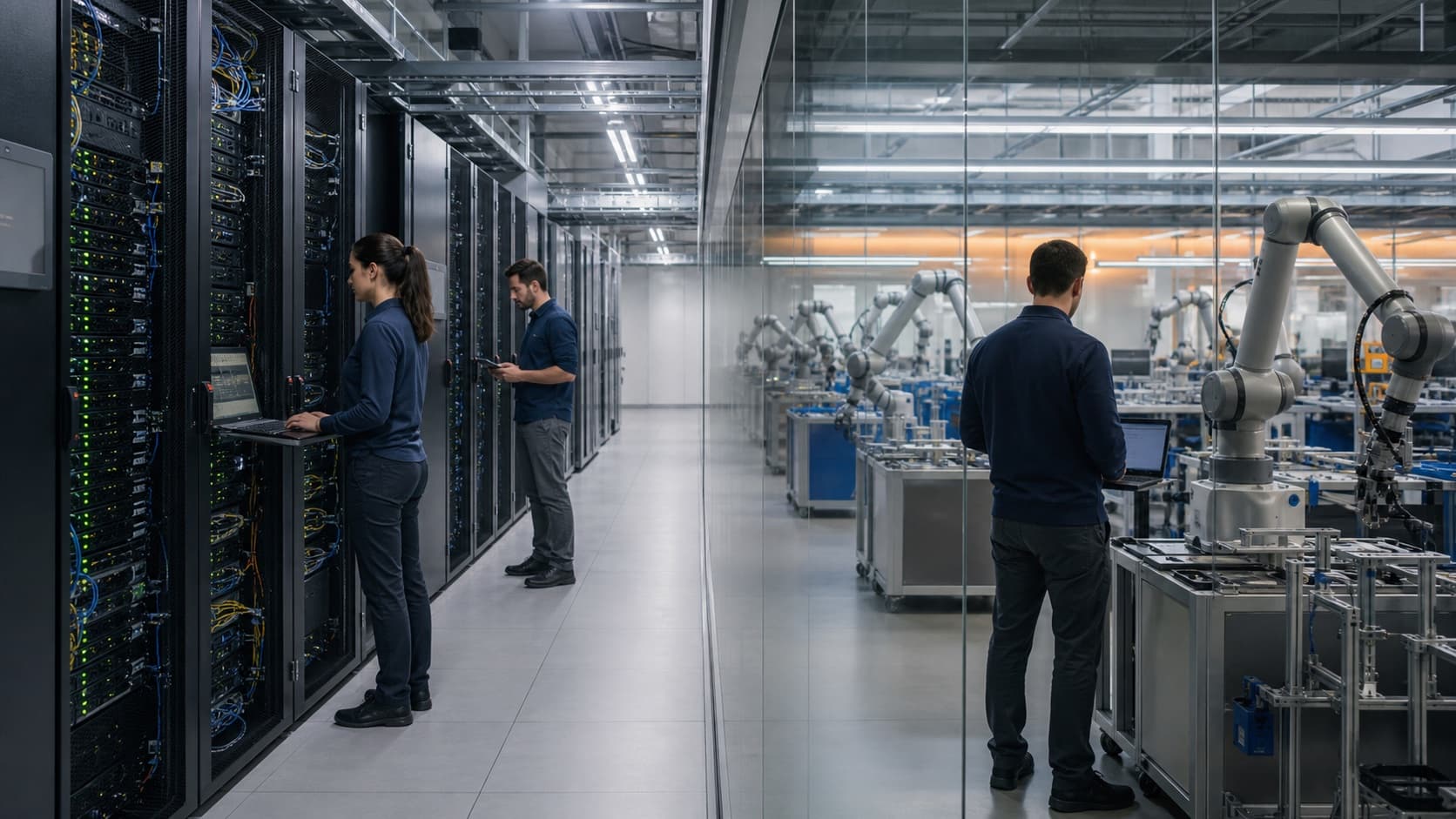
Every AI interaction depends on physical infrastructure: semiconductors, servers, networks, cooling systems, electricity and construction. The rapid expansion of AI therefore creates opportunities and bottlenecks far beyond software. NVIDIA announced in 2025 that Blackwell chip production had started at TSMC facilities in Arizona and described plans with manufacturing partners for AI-supercomputer production in Texas. These announcements illustrate the industrial depth of the AI supply chain. Advanced computing depends on fabrication, packaging, assembly, testing and power infrastructure, each with different lead times and concentrations of expertise. The strategic implication is that AI capacity cannot expand only through software demand. It must be matched by sites, grid connections, equipment and capital. Investors and business leaders evaluating AI should therefore watch energy systems, semiconductor capacity, construction constraints and supply-chain resilience as carefully as model benchmarks.
Data centers and energy demand
The International Energy Agency estimated that data centers consumed around 415 terawatt-hours of electricity in 2024, approximately 1.5 percent of global electricity consumption. In its 2025 base case, the IEA projected data-center electricity consumption to reach about 945 terawatt-hours by 2030. These are scenario-based estimates, not certainties, and the agency explicitly highlights uncertainty around adoption, efficiency and infrastructure bottlenecks. The local impact can be more significant than the global percentage suggests because data-center capacity is geographically concentrated. Grid connections, transformers, cooling, water availability and permitting can become binding constraints. At the same time, model and hardware efficiency continue to improve. Business leaders should avoid two simplistic conclusions: that AI energy use is irrelevant, or that growth is physically impossible. The responsible position is to examine workload value, efficiency, location and energy sourcing. Infrastructure should be treated as part of AI strategy, not as someone else's technical problem.
Cybersecurity, privacy and the expansion of the attack surface
AI systems can touch email, documents, customer records, browsers and operational software. Every additional tool connection can create value, but it also expands the attack surface. An agent with broad permissions can make a small model error operationally significant. Security design must therefore be architectural. Companies should minimize permissions, separate environments, protect credentials, log tool actions and require approval for consequential steps. Sensitive data should be governed before it enters prompts or retrieval systems. Teams also need procedures for prompt injection, manipulated documents and unreliable external content. The central principle is least privilege: an AI system should access only the data and actions necessary for its task. Observability is equally important. If management cannot reconstruct what information the system used, which tool it called and who approved the result, the workflow is not ready for high-stakes deployment.
Business opportunities: redesigning the decision cycle
The most durable business opportunity is not content generation. It is a shorter, better-controlled decision cycle. In sales, AI can qualify inbound requests, prepare account context and draft follow-up while the commercial owner controls the relationship. In finance, it can extract invoice data, match documents and route exceptions without approving payments autonomously. In operations, it can combine recurring reports into a management view. In procurement, it can monitor approved information sources and prepare supplier or market comparisons for review. These applications create value when they reduce waiting, rework or information loss. Leaders should demand a baseline before deployment: current cycle time, error rate, manual effort, backlog or missed follow-up. They should then compare the new workflow against that baseline. Without measurement, AI remains a story. With measurement and ownership, it becomes an operating improvement.
Risks every CEO should understand
The first risk is confident error. Models can produce plausible output that is not supported by evidence. The second is automation without accountability: a process moves faster, but nobody clearly owns the result. The third is data exposure through poorly governed tools or integrations. The fourth is dependency on a provider, model or workflow that may change. There are also organizational risks. Employees may distrust a system introduced without explanation, or over-trust it because management presented it as intelligent. Teams may automate a weak process and make its defects harder to see. A company may count activity rather than business impact. Governance should match consequence. Low-risk drafting can use lightweight review. Customer commitments, financial actions, employment decisions, safety and regulated activity require stronger controls. The CEO does not need to approve every prompt, but must ensure that decision rights, risk tiers and escalation paths exist.
How companies should prepare
Start with an operating map. Identify recurring decisions, their information inputs, their owners and the delays that damage performance. Select one workflow where the value is visible and the consequence of error is manageable. Create a controlled pilot. Use approved data, define the human review point and log the system's actions. Measure the baseline and the result. Include the employees who perform the work; they understand exceptions that are invisible in a process diagram. Build reusable foundations only after evidence appears. These foundations may include identity and access control, document retrieval, model evaluation, audit logs and vendor review. Avoid connecting every system at once. Finally, establish a review rhythm. AI performance, cost, security and business value can change. A workflow that worked six months ago still needs an owner today. The goal is not permanent experimentation. It is disciplined operational learning.
Key takeaways
AI in 2026 is moving from isolated assistance toward connected workflows and physical operations. Agents are most valuable when their objectives, tools, permissions and review points are bounded. Manufacturing, construction, healthcare and science offer substantial opportunities, but each requires domain evidence and human accountability. Data centers, semiconductors and electricity are strategic parts of the AI economy, not background infrastructure. The best first use case is a recurring process with measurable friction, trusted information and a clear owner. Governance should scale with consequence. Faster output is useful only when the organization can trust, review and act on it.
Conclusion: execution matters more than spectacle
The business revolution around artificial intelligence has only just begun because most organizations have not yet redesigned their operating systems around the technology. They have tested capabilities, but they have not consistently connected data, tools, permissions, people and measurement. That is the work now. The winners will not necessarily be the companies with the most models or the largest number of pilots. They will be the companies that choose meaningful problems, build controlled workflows and learn faster without abandoning accountability. AI should make an organization more informed, more responsive and more disciplined. If it only makes the organization produce more content, it has not yet reached its strategic potential.